
Single Stock Spotlight #2: CROX
The market thinks Crocs is melting. The numbers suggest otherwise.

I launched the Single Stock Spotlights series last week with great success, highlighting my favorite chemical producer Celanese (CE).
The timing couldn’t have been more perfect, with CE up from $48 at time of article publication to $59 currently, for a cool 20%+ gain.
Today’s single stock spotlight is my favorite consumer discretionary play, Crocs (CROX), which sells the eponymous Crocs clogs as well as Hey Dudes casual lifestyle shoes.

I will apply the same framework I used for Celanese to demonstrate why I believe CROX still has 50%+ upside even after today’s big earnings gain.
WHAT: What should the stock be worth vs. what it’s trading for today?
WHY: Why is the market mis-pricing the stock, and what is the “variant perception” that the market is missing?
HOW: How will this valuation gap be closed? What are the catalysts that can close this gap and prove your variant perception to be true?
WHEN: A cheap stock can get cheaper. It needs catalysts (see point #3) as well as incoming fund flows to reverse the downward momentum. Technical analysis can visually show momentum reversal and cue that the stock is ready to go higher
WHAT: What Should CROX Be Worth?
Today, CROX trades at a 7-9x forward P/E and a free cash flow yield in the mid-teens.
Those are liquidation-type multiples.
But Crocs is not a liquidation story.
Business Reality:
~$4B+ global revenue platform
Gross margins >55%
Operating margins mid-20s
$700–800M+ annual free cash flow
Aggressive share repurchases
Rapid post-acquisition deleveraging
If we assume:
Flat to low-single-digit long-term revenue growth
Stable margins
Continued buybacks
Normalized EPS power over a cycle reasonably lands in the $12–14 range.
If we assume the business will never grow earnings, it would merit a conservative 10x multiple (assumes a 10% cost of equity with 0% growth), and intrinsic value is: $120 per share.
However, this is where the power of aggressive and opportunistic buybacks come into play.
Management generated ~$659M in free cash flow for 2025 and plowed $577M into buybacks (6.5M shares), representing almost 90% of free cash flow.
This buyback also retired ~13% of total CROX shares outstanding in just 1 year!
This is truly next level type pace in share buybacks…if they continue at this pace, management can take the entire company private in 10 years (of course that would never happen since the stock price would go to infinity but still…)
For 2026, management guided to earnings growth of 3-5% from 2025 EXCLUDING impact of share buybacks.
Barring some catastrophe, I fully expect management to follow a similar playbook and plow the cash flow into buying back shares.
If CROX buys back another $577M in 2026 at the current price of ~$100 per share, this would retire 13% of the shares.
Now the earnings per share increases from less than $13 in 2025, to ~$15 per share in 2026.
Wash, rinse, and repeat a similar buyback program in 2027 to retire another 13% of shares, and you get earnings per share of almost $17.5 per share!
Applying the similar 10-12x multiple to this 2027 hypothetical earnings now gets you to a target price of $170-$210 per share, or almost double the current stock price!
As long as shares remain undervalued and management plows the cash flow back into buybacks, they can juice earnings growth and force the stock price to head higher.
WHY: Why Is the Market Mis-Pricing CROX?
The market narrative centers around three fears.
1. “The Crocs brand is a fad.”
Investors remember the 2006–2008 boom and bust and assume this is cyclical fashion hype.
Variant Perception:
This is not 2007 Crocs.
Today’s Crocs:
Higher DTC mix
Global distribution scale
Strong digital presence
Cultural collaborations driving relevance
Supply chain discipline
The brand has survived multiple cycles and broadened beyond a single silhouette.
The market sees fashion risk.
The numbers show brand durability.
2. “HeyDude Was a Mistake.”
The $2.5B acquisition of HeyDude pressured sentiment due to wholesale softness and inventory resets.
Variant Perception:
HeyDude is in a reset — not in decline.
Distribution rationalization improves brand equity
Inventory cleanup restores margin
Shared infrastructure lowers costs
Management focused on profitability over growth
The market is pricing HeyDude as a permanent drag.
If it merely stabilizes, earnings power rises materially.
3. “Consumer Discretionary Is Weak.”
Macro fears (rates, inflation, tariffs) create broad retail discounting.
Variant Perception:
Crocs is:
Affordable
High-margin
Cash generative
In downturns, consumers trade down — not out — of footwear purchases.
CROX is not a luxury cyclic. It’s a value-priced branded product with pricing power.
HOW: How Does the Gap Close?
The stock doesn’t need hyper-growth. It needs normalization.
Catalyst #1: Earnings Stability
Two or three consecutive quarters of:
Margin durability
Clean inventory
No negative surprises
The “melting ice cube” thesis weakens.
Catalyst #2: HeyDude Stabilization
Flat year-over-year growth becomes the trough signal.
Once investors see:
Stabilized revenue
Margin recovery
Sentiment shifts quickly.
Catalyst #3: Buybacks at Deep Value
This is the most important catalyst in my opinion.
I have shown in section #1 how the massive buyback program that management has deployed can force earnings per share much higher even if overall earnings stay flat and/or grow at low to mid single digits.
At current depressed price to earnings and price to cash flow multiples, buybacks are extremely accretive!
As the buyback impacts flow through to the future financial results (earnings per share, cash flow per share), I believe this will provide the biggest lift to the stock price
WHEN: Timing the Turn
Cheap stocks can stay cheap.
Momentum must reverse.
Here’s what I am watching from a technical perspective to understand when the turn will occur:
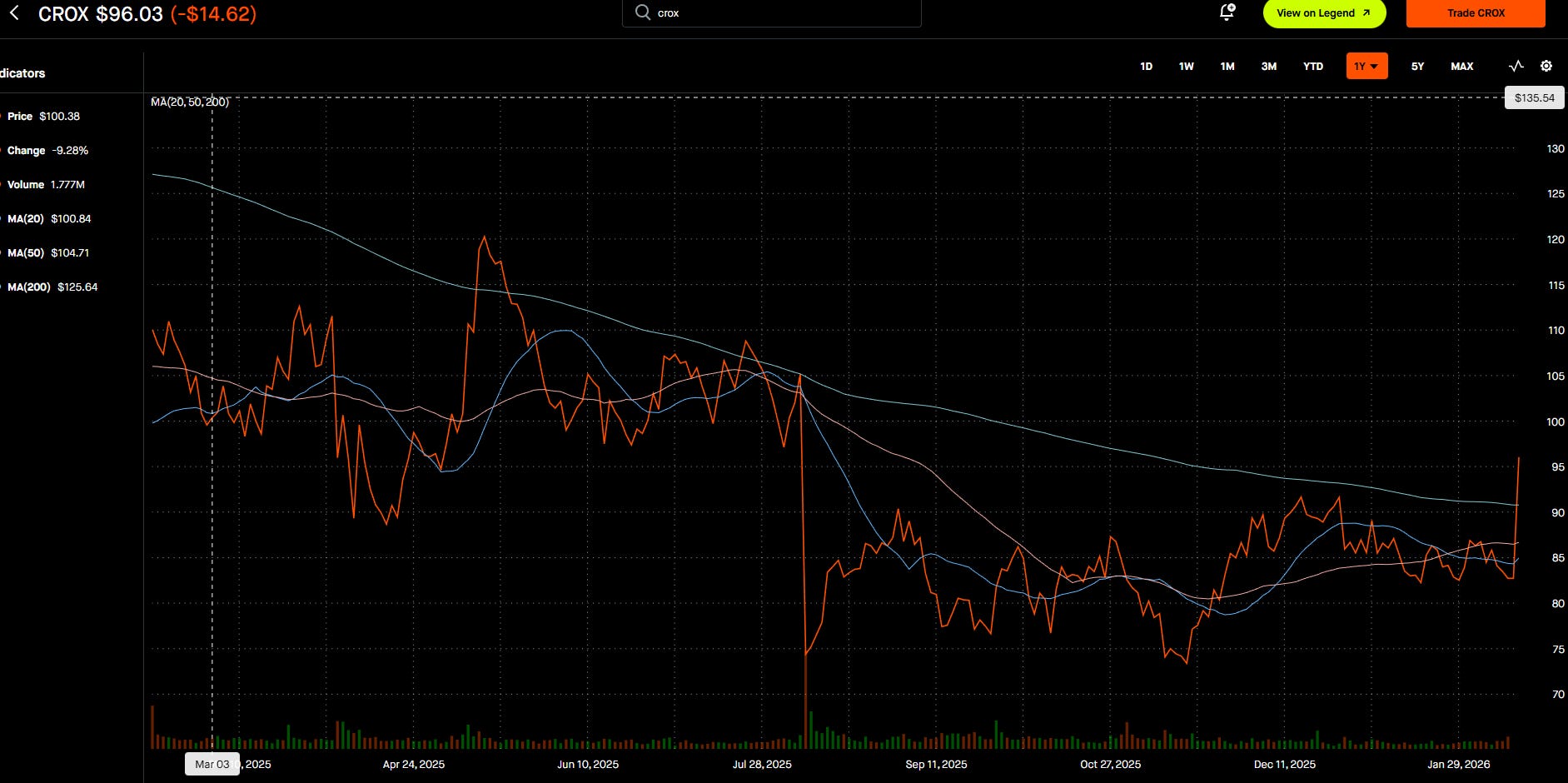
As we can see from the 1-year chart, CROX has broken above all 3 key moving averages (20 day, 50 day, and 200 day).
If the stock price can keep its head above the 200 DMA (top line) in the coming weeks, this would denote a bullish trend reversal from the strong downward momentum that the 200 DMA has represented over the past 12 months.
All in all, a very bullish technical setup for CROX, which we like to see in addition to the positive fundamentals.
The Bottom Line
CROX is priced as a melting ice cube.
But the company is generating elite margins, substantial free cash flow, and reducing share count aggressively through a massive buyback program.
If Crocs simply proves it is not deteriorating, earnings per share growth from buybacks can drive substantial upside.
Based on earnings per share growth I expect over the next few years from business stabilization and continued massive buybacks, I am setting a target price of $170-$210 for CROX, representing a double from its current stock price around $95 per share.
Disclaimer: I currently own CROX and may buy or sell more at any time. This is not investment advice, please do your own due diligence.
EBIT margins have been trending downward when looking at them on a fiscal quarter basis. Ever since the 2021 peaks, we’ve seen a steady decline. This could be attributed to international expansion, but sales are also decelerating. Although international revenue grew 14%, they are coming off a period of much stronger growth and are guiding for only 10% next year. It makes me wonder if the brand is that strong or just a covid trend. What’s your take on these numbers?
I understand the middle-class consumer is under pressure. Perhaps parents are skipping that second pair of Crocs they used to buy. In contrast, Deckers (DECK) shows a much more consistent trend of margin expansion and robust growth. While it trades at a higher multiple, its debt-free balance sheet and surging UGG sales tell a different story. It seems high-income consumers remain resilient and willing to spend. Honestly, I’m not convinced Crocs' Q4 results were as strong as they seem.